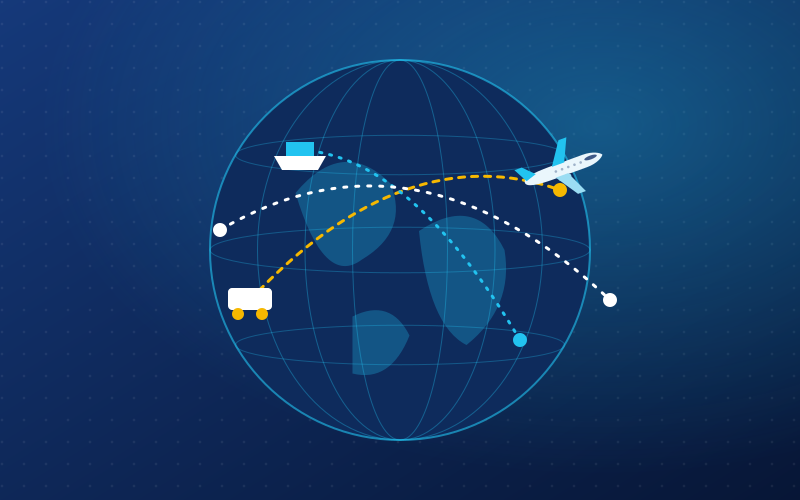
Supply chain management is the coordination of everything involved in getting a product from supplier to customer: planning, sourcing, production, inventory, warehousing, transport and returns. The aim is to meet customer demand reliably at a sensible total cost, while managing risk and keeping information flowing between partners.
Key takeaways
- Supply chain management looks at the whole flow, not only freight or warehousing in isolation.
- Total landed cost and service reliability matter more than the lowest price on any single step.
- Visibility, meaning knowing where goods and orders are, is a practical first improvement.
- Supplier concentration, port delays and documentation gaps are common risks to plan for.
- Many businesses use a logistics partner for the parts they do not want to run in-house.
What are the main components of a supply chain?
Planning
Demand forecasting, production schedules and inventory targets form the plan. Forecasts are never perfect, so good planning includes buffers and review points instead of a single fixed number.
Sourcing and procurement
Selecting suppliers, negotiating terms and managing quality. Delivery terms matter here. The agreed Incoterm determines when risk and cost pass from seller to buyer, so it is worth understanding Incoterms 2020 before signing contracts.
Production or assembly
For manufacturers, this step determines lead times and batch sizes. For traders, it may be replaced by consolidation or repacking.
Logistics and transport
Moving materials and goods by air, sea or road, including customs clearance for cross-border trade. See sea freight and air freight for the modes most used in international movement.
Warehousing and inventory
Holding stock close enough to demand to serve customers, without tying up excessive cash. More detail is in our guide to warehouse and distribution management.
Returns and after-sales
Handling returns, repairs and replacements. This is often overlooked in planning but affects cost and customer satisfaction.
Why does supply chain management matter?
- Cost control: visible costs such as freight sit alongside hidden ones such as expedited shipments, stockouts and excess inventory.
- Customer service: reliable delivery depends on coordination between suppliers, carriers and warehouses.
- Cash flow: inventory and payment terms directly affect working capital.
- Compliance: import and export rules, documentation and product regulations need to be considered at planning stage, not at the port.
What challenges do Indian importers and exporters commonly face?
Challenges vary by industry, but several recur: variable lead times from overseas suppliers, documentation errors that delay clearance, congestion or schedule changes at ports and airports, fluctuating freight rates and exchange rates, and limited visibility between handoffs. Regulatory requirements can also change, so verify current rules on official government sources. Our guides to importing goods into India and exporting goods from India cover the basics of cross-border processes.
How can you improve your supply chain step by step?
- Map the flow. Write down every step from supplier to customer, with the responsible party and typical time at each stage.
- Identify the weakest points. Look for repeated delays, frequent errors or steps with no clear owner.
- Standardise documents and data. Use consistent product descriptions, codes and formats across invoices, packing lists and orders.
- Improve visibility. Agree on shipment milestones and how updates are shared. A shipment tracking facility can help for in-transit cargo.
- Review inventory policy. Revisit safety stock and reorder points in light of actual lead times, not assumed ones.
- Diversify where practical. Relying on one supplier, one port or one carrier increases exposure to disruption.
- Measure and review. Track a small set of indicators such as on-time delivery, order accuracy and inventory turnover.
How should you think about risk?
List the events that could interrupt your flow: supplier delay, quality failure, port congestion, documentation rejection, transport breakdown or demand spike. For each, note the likely impact and a basic response, such as an alternate supplier, buffer stock, a different routing or cargo insurance. A short written plan is more useful than an elaborate one that nobody reads.
When should you involve a logistics partner?
A partner can make sense when you lack in-house capacity for freight coordination, customs, warehousing or transport, or when you want to scale without building infrastructure. Look at the scope carefully: some partners manage single tasks, while others take on an integrated role under supply chain management or contract logistics arrangements. Define responsibilities, reporting and communication in writing.
How United Cargo & Travels can help
United Cargo & Travels Pvt. Ltd., based in New Delhi, supports importers and exporters with freight forwarding, customs clearance support, warehousing, transport and EXIM consultancy, as well as supply chain and contract logistics support. Scope and timelines depend on the cargo, route and documents involved, so we review each enquiry individually. To discuss your requirement, request a quote.